Buddhist Equality and Non-attachment
Demi-Gods and Semi-DevilsBuddhist Equality and Non-attachment is expressed through Zhiguang’s dust-written teaching that distinctions of species, ethnicity, virtue, and reputation are ultimately no more substantial than dust. Its importance lies not only in the doctrine itself but in the response it draws from Xiao Feng: he recognizes the force of seeing Han and Khitan as equally transient categories, yet cannot readily release the grievances and responsibilities attached to them. A'Zhu carries the teaching from the temple into their shared future, proposing a life beyond Yanmen Pass away from the Central Plains’ contests of kindness, enmity, honor, and disgrace.
The teaching written in dust
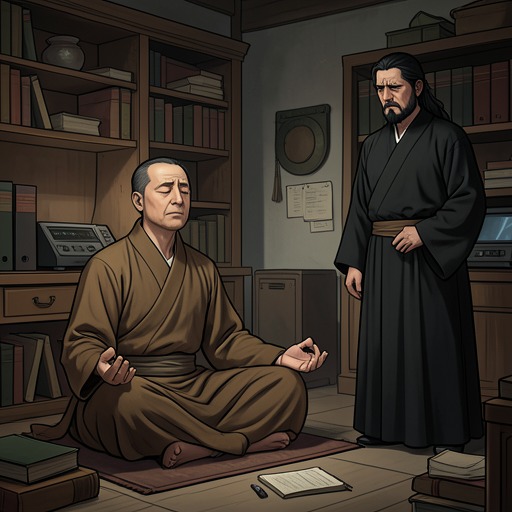
In the small house at Zhiguan Temple, Zhiguang sits cross-legged on a bulrush mat and writes on the unswept floor, where a thick layer of dust has gathered. His lines place sages and animals on equal terms and say that Han and Khitan are at once reality and fantasy. Kindness, enmity, honor, and disgrace, too, are described as mere dust. The material of the writing makes its point concrete: categories that seem weighty enough to govern a life are set down in a substance easily disturbed and ultimately transient.
The teaching is framed as a series of equivalences rather than a defense of one side against another. Its scope extends from human beings to animals, from social virtue to wrongdoing, and from ethnic identity to reputation. By bringing these oppositions together, Zhiguang presents worldly distinctions as part of the same field of impermanence, rather than as grounds for lasting separation or judgment.
Xiao Feng’s response
Looking at the writing, Xiao Feng understands the Buddhist implication: if humanitarians and villains are not ultimately different, and neither are people, animals, hungry ghosts, emperors, and generals, then his identity as Han or Khitan may not deserve the weight placed upon it. Yet understanding the argument does not make him a Buddhist or allow him to detach himself at once. He asks Zhiguang to identify the leading big brother, returning from the broad proposition of equality to the unresolved question of who bears responsibility for the events that have brought him there.
That tension is essential to the teaching’s effect. The doctrine offers a vantage from which ethnic division and worldly honor lose their permanence, but Xiao Feng’s life remains entangled in the consequences of those divisions. The narrative does not portray him as suddenly liberated by a maxim. Instead, his hesitation marks the distance between seeing an attachment as transient and being able to live without it.
From principle to proposed life
After Zhiguang’s death, Xiao Feng and A'Zhu leave the temple. More than ten li into their journey, Xiao Feng says he had no intention of harming the monk and wonders why Zhiguang made himself suffer. A'Zhu interprets the monk as having understood the world and become so enlightened that life and death were alike to him. Their exchange carries the teaching beyond its written form: the question of non-attachment now bears on how they understand Zhiguang’s death and their own pursuit of the truth behind the violence surrounding them.
A'Zhu then applies the lines to Xiao Feng’s circumstances. She suggests that Han or Khitan makes no difference and that he may be tired of living amid the Central Plains’ martial conflicts. Rather than continuing to heed its concerns with kindness, enmity, honor, and disgrace, he could go beyond Yanmen Pass to hunt and herd animals. Xiao Feng admits that he is tired of struggling to survive at the point of a saber and imagines galloping, releasing eagles and dogs, and chasing rabbits in the northern grasslands. When he asks whether A'Zhu will visit him there, she answers that she meant to herd cattle and sheep while he hunts. The teaching thus becomes more than an abstract dismissal of distinctions: it opens the possibility of a shared life outside the world that has made those distinctions so consequential.
Meaning and limits
The episode holds renunciation and attachment together. Zhiguang’s writing declares that identity and reputation are ultimately dust; Xiao Feng, however, remains concerned with the unresolved accusation against him, and his wish for a different life takes shape through his bond with A'Zhu. The teaching does not erase those circumstances. It gives them another scale, while A'Zhu’s proposal translates that scale into a concrete alternative: leave the jianghu of the Central Plains and live beyond the pass.
Its force therefore rests on both its broad reach and its human limit. The lines place Han and Khitan within the same impermanent order, but Xiao Feng cannot simply become detached because he has heard them. He can nevertheless recognize his exhaustion and imagine a future no longer organized around martial struggle and public judgment. Buddhist Equality and Non-attachment is at once Zhiguang’s final written teaching and the principle through which A'Zhu and Xiao Feng begin to envision that future.